6 min read
Design tokens explained: a practical guide
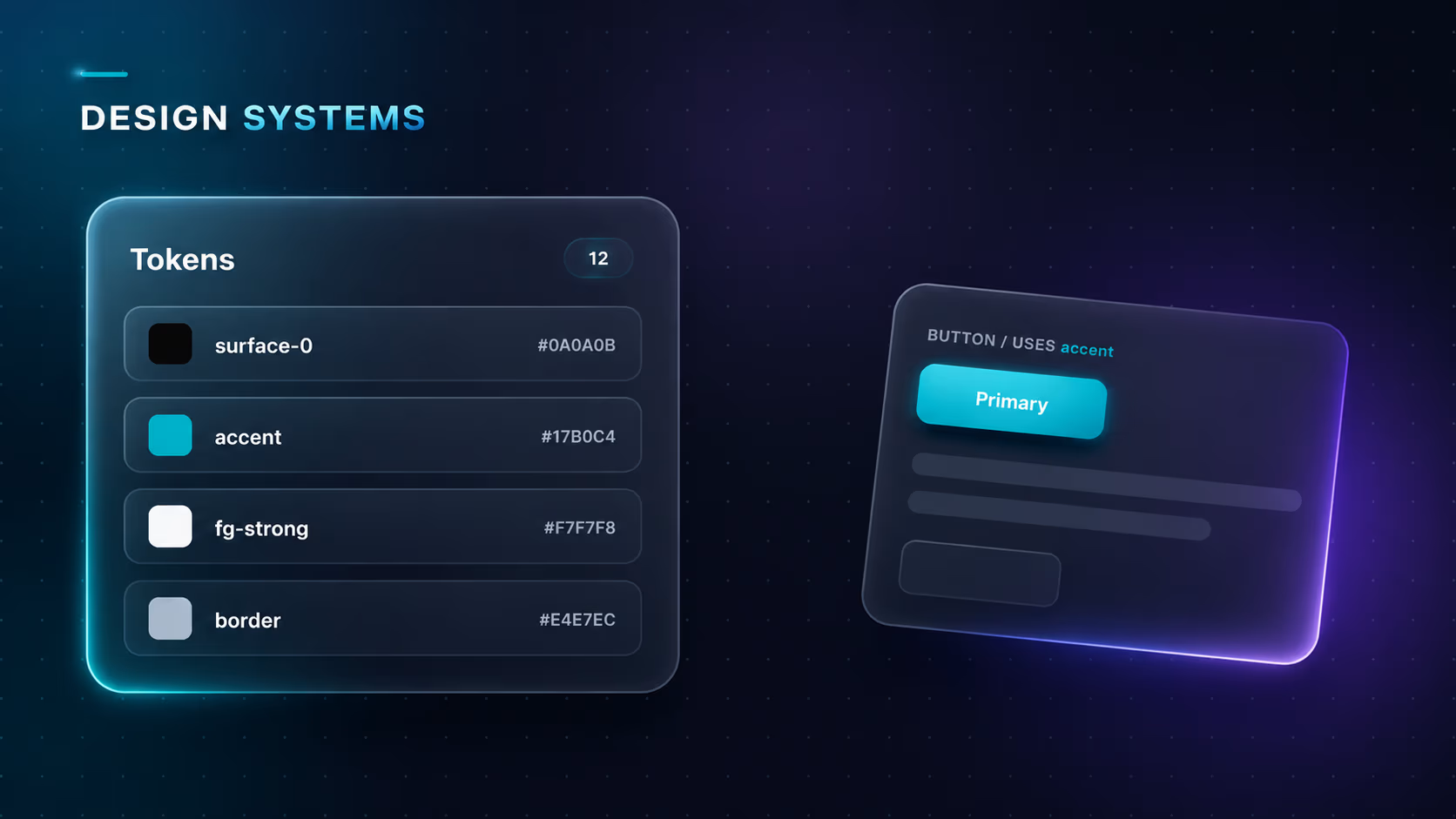
Tokens are the contract between design and engineering. What they are, how to name them, and how to keep them from turning into a mess.
design systemstokenstheming

Engineering & Frontend
The handoff is where quality leaks out. The design engineer role, and the practices that make the built product match the intent.
TL;DR
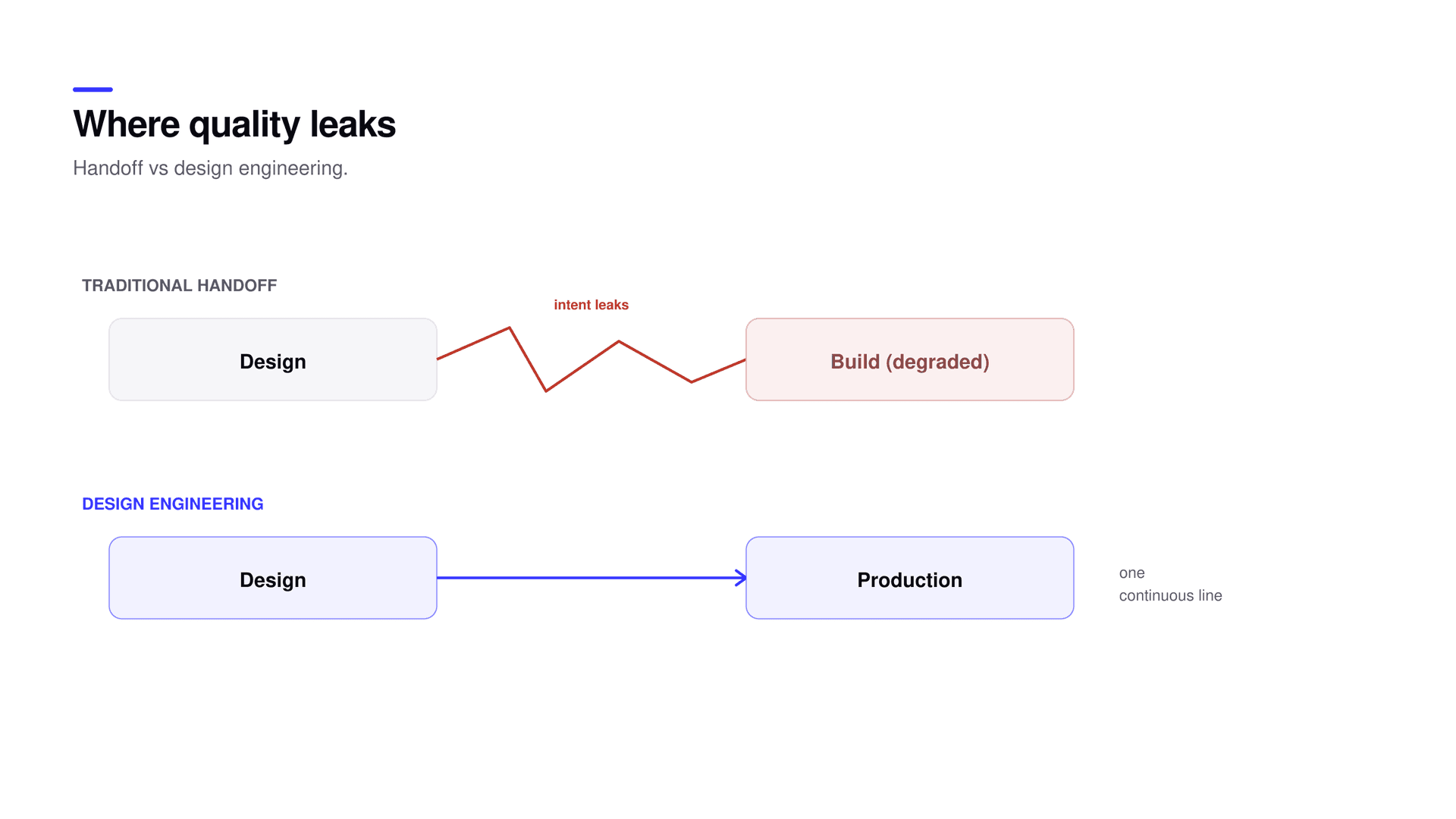
Most product quality is lost in translation. A design is decided in one tool and rebuilt in another, and the intent quietly degrades at every step. The spacing drifts by a few pixels here and there. The motion that made an interaction feel alive was never in the mockup, so it never gets built. The empty state, the error, the too-long name, none of them were designed, so an engineer guesses. And the shipped thing ends up feeling a little cheaper than the picture everyone signed off on, without anyone being able to point to exactly where it went wrong. Design engineering closes that gap by holding the same craft standard on both sides of the handoff. This covers why the handoff leaks quality, the three moves that fix it, what a design engineer actually does day to day, and why one person who owns the last mile beats any amount of documentation.
The problem
A traditional handoff treats the design as a specification to be reconstructed from scratch in code. The trouble is that a static mockup cannot express several of the things that decide whether a product feels good: motion and transitions, how a layout behaves at every width between mobile and desktop, how it holds up with real data instead of tidy placeholder text, and the full set of states a real screen has to handle, loading, empty, error, partial, too much. So the engineer fills those gaps with guesses under deadline, and the quality that lived in the details leaks out through every gap. The instinct is to fix this with more detailed specifications, but that does not work either. A hundred-page redline still cannot anticipate every case, and nobody reads a hundred pages while shipping. The real fix is to remove the wall between the two sides so the thinking survives the trip from idea to production.
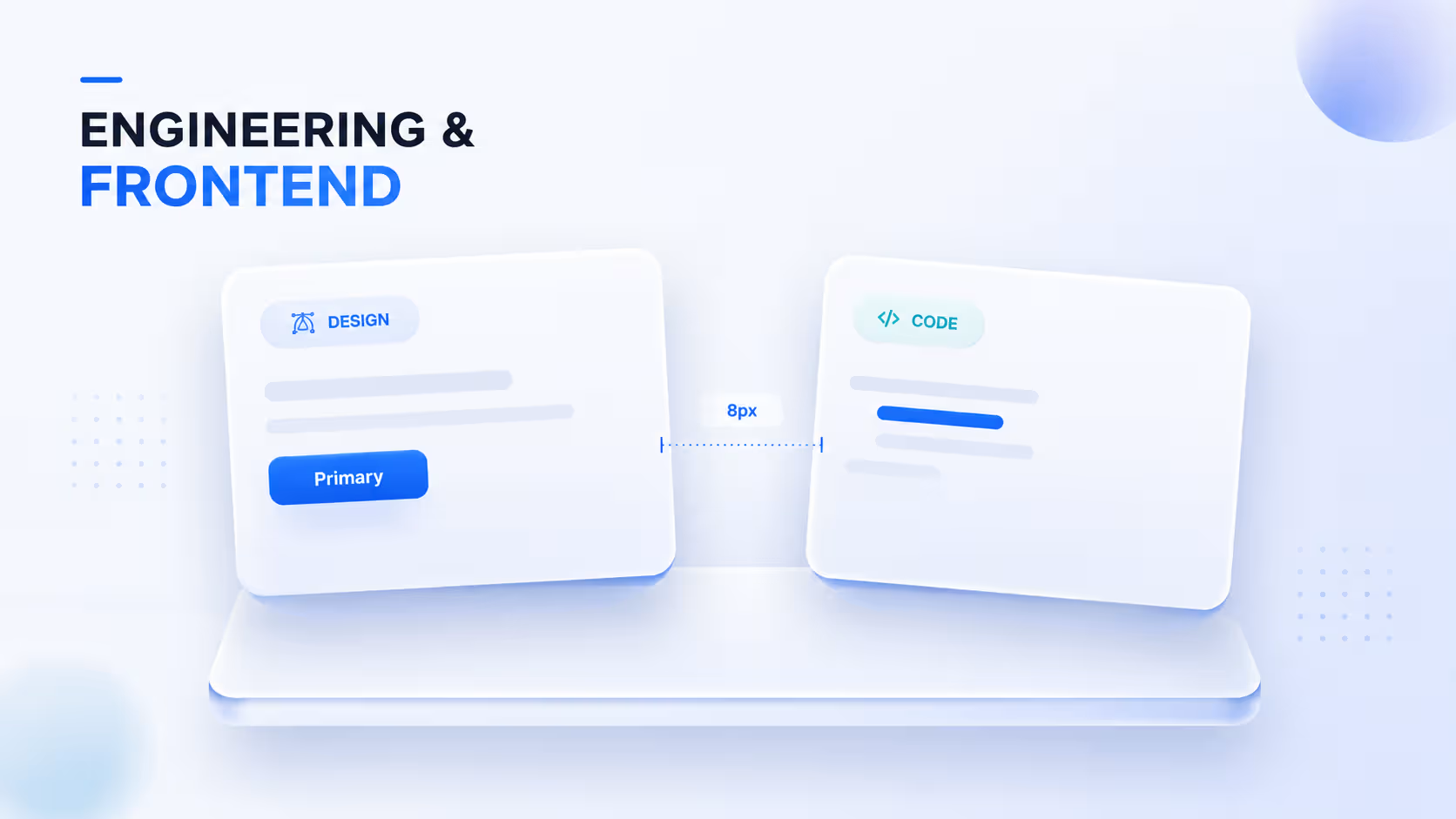
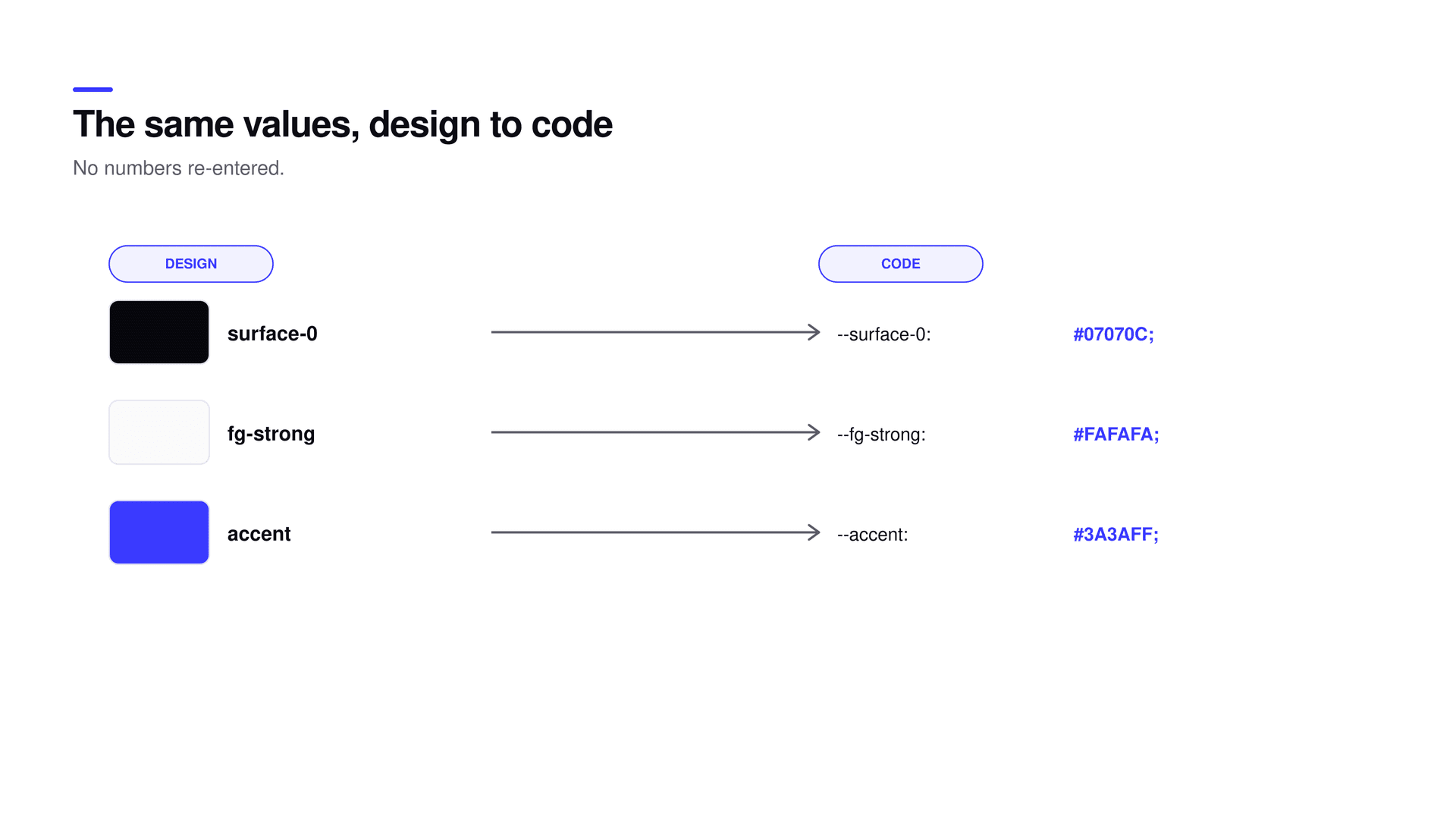
Three practical moves close most of the gap. Share a token layer, so the values in the design are literally the values in the code rather than numbers an engineer re-enters by hand and gets slightly wrong. Build from a real component library, something like a Storybook backed by those same tokens, so the interface is assembled from the actual parts the design uses instead of reconstructed from flat screenshots. And review the running product, not just the mockup, because motion, states, and responsive behavior only exist once it is live, and reviewing the static picture systematically misses exactly the things that leak. Do these three and the built thing stops being an approximation of the design and starts being the design, running.
| Handoff problem | Design-engineering fix |
|---|---|
| Values re-entered by hand, and drift | One shared token layer, design and code |
| Rebuilt from flat screenshots | A real, shared component library |
| Motion and states missing | Review the running product, not the mockup |
| Edge cases never designed | One owner who catches them during the build |
The role is easier to understand through its day than its title. A design engineer takes a flow from close-to-final design into production and makes the hundred small decisions that a mockup left open. They decide how a list animates as items load, how a card reflows when the text is twice as long as the placeholder, what the error state says and looks like, how focus moves when a dialog opens, and how the whole thing feels on a slow connection. They work in the shared token and component system so their choices stay consistent with everything else, and they raise the questions the static design did not answer rather than guessing silently. The work sits deliberately across the old boundary: enough design sense to know what good feels like, and enough engineering to build it well and fast.
The role
A design engineer speaks both languages and owns the last mile, where a design becomes a fast, accessible, responsive interface. That single point of ownership is what keeps the final product feeling considered instead of assembled from parts.
You can write the most detailed handoff document in the world and still lose the details, for two reasons that no document overcomes. First, a specification cannot anticipate every case, and the cases it misses are exactly the ones that need judgment. Second, nobody reads a long specification carefully under deadline, so even the anticipated cases get skimmed. A person who holds both the design intent and the implementation reality makes those hundred small calls correctly in the moment: how the empty state should feel, what the transition communicates, how the layout survives a slow network or a long string. On a product where craft is the differentiator, that is not a nice-to-have. It is the difference between a product that feels considered and one that feels assembled. The shared system this person works from is your token layer and component library; the discipline is what makes those systems actually pay off in production instead of just existing.
The last ten percent of quality lives in the handoff, and it is exactly the ten percent users feel first.
What is design engineering?
Design engineering is the discipline of carrying design intent all the way into production at the same craft standard, rather than treating the handoff as a specification to reconstruct. A design engineer works across design and front-end code and owns the last mile where a design becomes a real interface.
How is a design engineer different from a front-end developer?
A front-end developer implements to spec. A design engineer holds both the design intent and the implementation reality, making the small judgment calls, on motion, states, and responsiveness, that a spec cannot capture. The role exists to stop quality leaking in translation.
How do you close the gap between Figma and production?
Share a token layer so values are identical in design and code, build from a real component library instead of screenshots, and review the running product rather than the mockup so motion, states, and edge cases are actually judged.
Why not just write a more detailed handoff document?
Because a document cannot anticipate every case and nobody reads a long one under deadline. A shared system plus one owner who makes the hundred small calls in the moment beats any static spec.
When should a team hire a design engineer?
When the shipped product keeps falling short of the mockups on motion, states, and polish, and when craft is a real differentiator for the product. That gap is the signal that the last mile needs an owner.
When design and engineering share tools, standards, and a person who bridges them, the handoff stops being a cliff and becomes a continuous line from intent to production. That is where the last ten percent of quality lives. It rests on a solid token layer and a right-sized design system, and it is the production side of how to use AI without lowering the bar. If your shipped product never quite matches the mockup, the gap can be closed.
Related reading