6 min read
How much does product design cost, and why
A straight answer for founders on what product design actually costs, what drives the number, and how to spend it well.
pricingfoundersengagements

Product Strategy
A straight framework for founders deciding between a first design hire and an external studio, and how to get the timing right.
TL;DR
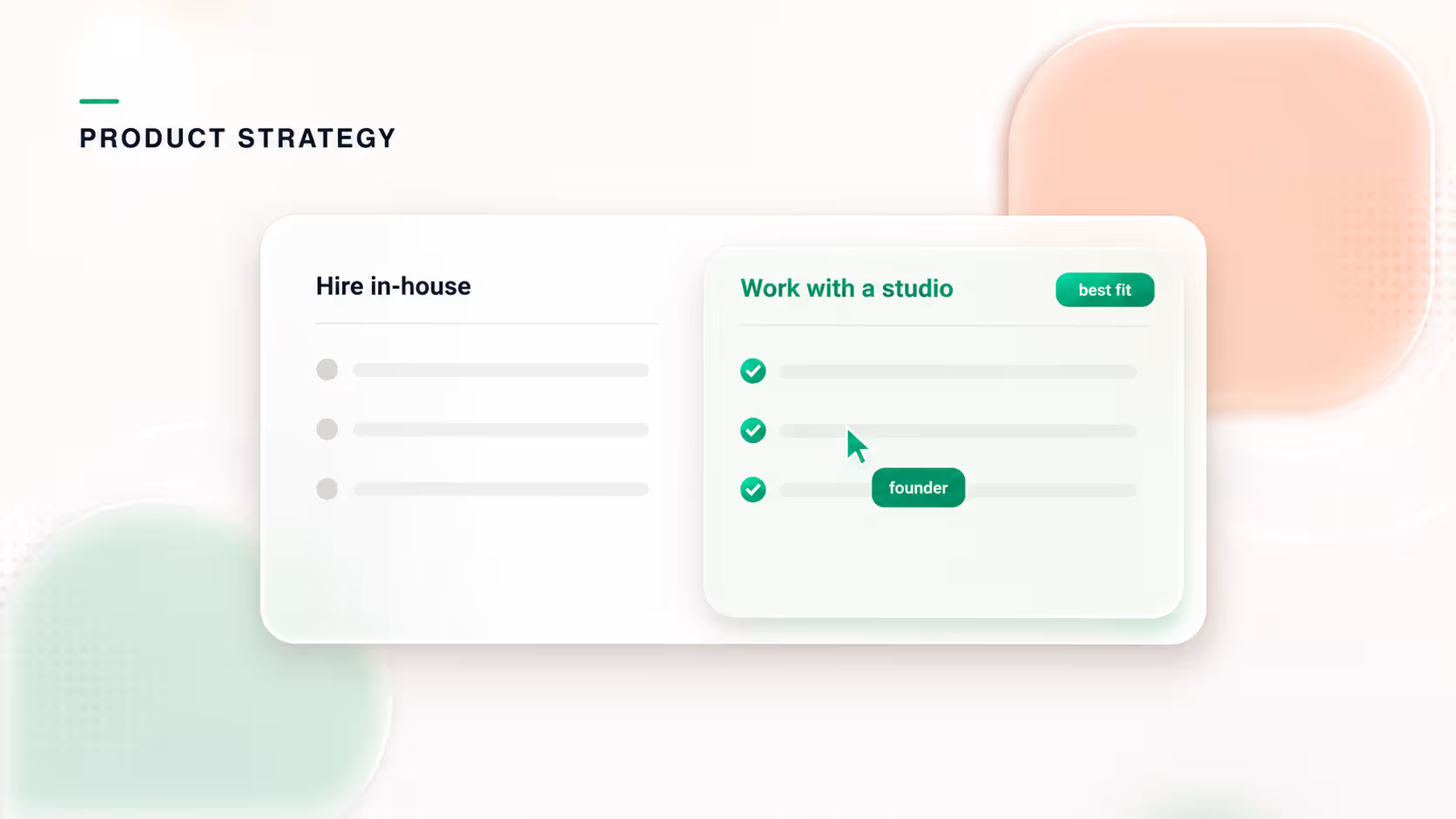
The choice between a first design hire and an external studio looks like a budget question and is really a question about two things: whether your design needs are steady or spiky, and how soon you need senior judgment in the room. Get those two right and the decision mostly makes itself, and you avoid the two expensive mistakes that trap most teams. This lays out a straight framework for the choice, the sequence that works for most companies, the mistakes to avoid, and an honest note on where a studio’s advice, including advice like this, carries a bias worth accounting for.
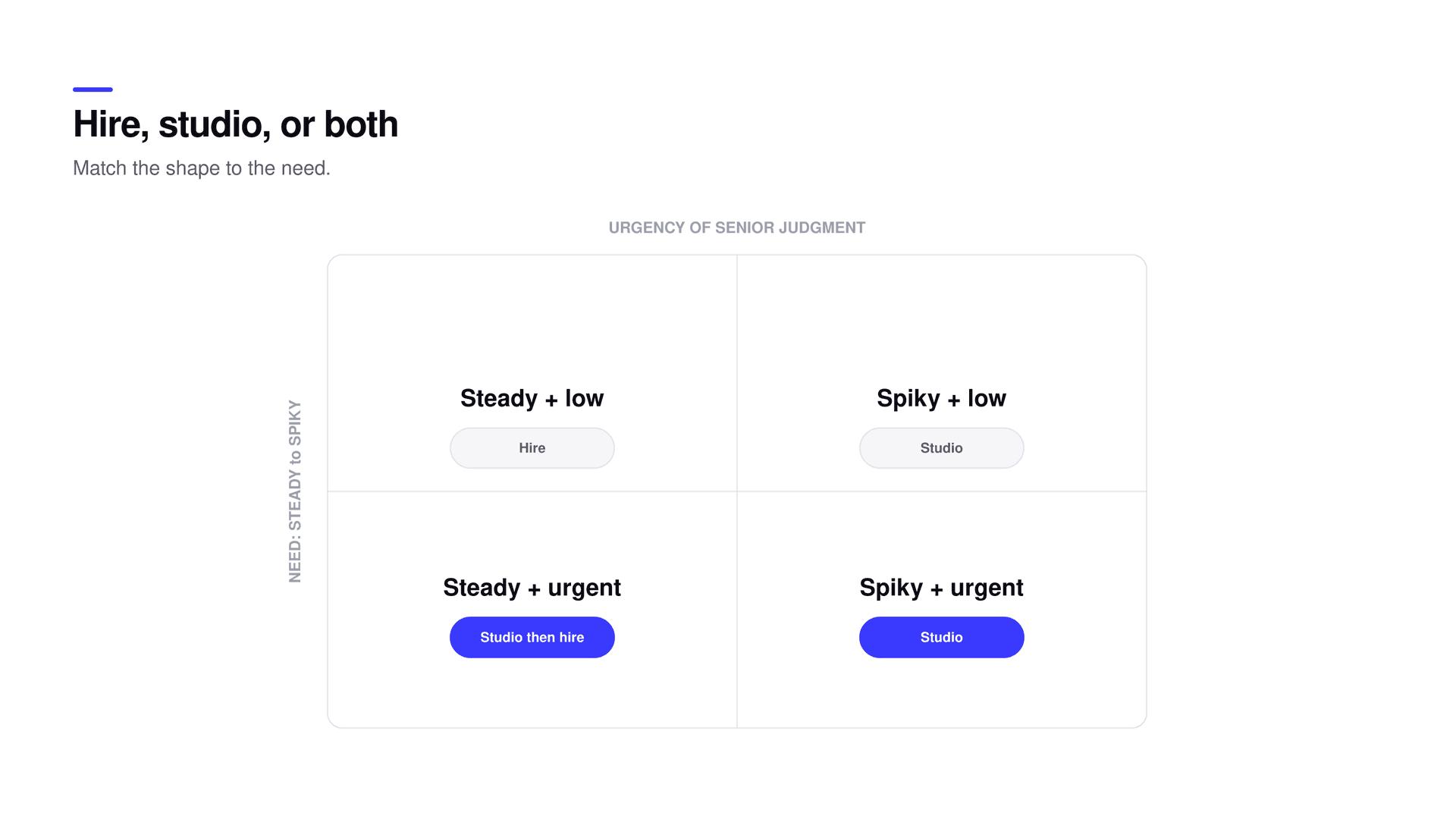
| If the need is... | Choose | Because |
|---|---|---|
| Steady, core, everyday | A hire | Compounding value and full-time focus |
| Spiky, time-boxed, in bursts | A studio | Range on demand, no fixed cost |
| Broad across skills at once | A studio | Strategy, interface, motion, and engineering together |
| Urgent, senior, needed now | A studio | No hiring cycle to wait out |
Hire when
Bring someone in-house when three things are true at once. There is enough ongoing design work to keep a person genuinely busy and embedded, not idle between occasional projects. Design is central to the product every week, not a finishing step applied at the end. And you can actually attract someone strong, which means the role and the company are compelling enough that a good designer would choose it. When those hold, a great first designer does far more than produce screens. They shape the product direction and set the culture of quality that everyone else calibrates to, and that influence compounds over months in a way no external engagement can. But the compounding only happens if the work is steady enough to justify a full-time seat and strong enough to attract real talent. If you cannot yet offer both, a hire will underdeliver, and it will not be the person’s fault.
Studio when
Work with a studio when the shape of the need is different. When it is time-boxed or arrives in bursts rather than as a steady stream, so a full-time seat would sit idle between peaks. When it spans a range of skills at once, strategy and interface and motion and front-end engineering, that you would otherwise have to hire for one at a time. Or when it is urgent and senior and you cannot wait out a hiring cycle that realistically takes months for a good designer. A studio brings a team’s worth of range for a defined push, without the fixed cost and the lead time of assembling that range through hiring. The honest caveat, since this is a studio’s point of view, is that this framing is not neutral, so weigh it against your own read of how continuous your design work truly is and how soon you could realistically hire someone good.
The common sequence
Many teams do both, in order: a studio to set the standard and ship the first strong version, then an in-house hire to carry it forward with the bar already established. The studio de-risks the early product; the hire owns the long game.
Two errors account for most of the stories that end badly. The first is hiring junior for a senior problem because the budget stretched further that way, and then watching the product learn on itself while a first-time lead figures out the fundamentals in production, in public, on your timeline. Seniority is not a luxury on the decisions that shape the whole product; it is the thing that prevents expensive early mistakes. The second is hiring at all before you know what the role should own, so the person arrives to a scattered mandate, spends months trying to define their own job, and the work stays fragmented. The fix for both is the same. Decide what the design function actually needs to own first. Then choose the shape, a hire, a studio, or both in sequence, that puts senior judgment on that problem soonest.
Once the shape of the need points you one way, a little diligence protects the decision. If you are hiring, write down what the role owns before you post it, interview for judgment on real problems rather than portfolio polish alone, and be honest about whether you can offer work interesting enough to keep a strong designer. If you are choosing a studio, look for range that matches your gaps, ask to see shipped products rather than concept work, and agree on what "done" means and who owns the last mile into production before anything starts. In both cases the thing you are really buying is senior judgment applied to your specific problem, so evaluate for that and not for the artifacts that are easy to show in a first meeting.
There is no universally right answer, only a right answer for your stage. The goal is senior judgment on your product as early as the work justifies it.
Should a startup hire a designer or work with a studio?
Hire when design is continuous and core to the product and you can attract someone strong. Use a studio when the need is spiky, spans several skills at once, or is urgent enough that you cannot wait out a hiring cycle. Many teams do both in sequence.
What does a studio give you that a first hire does not?
A team’s worth of range, strategy, interface, motion, and engineering, plus senior judgment and a standard, immediately and without hiring for each skill. The trade-off is that it is engaged for a defined push rather than embedded full time.
What is the biggest hiring mistake teams make here?
Hiring junior for a senior problem to save budget, then watching the product learn on itself. A close second is hiring before defining what the role should own, which leaves the work scattered and the person without a clear mandate.
Can you use a studio and a hire together?
Yes, and it is a common and effective sequence. A studio sets the standard and ships the first strong version, then an in-house hire carries it forward with the bar already established. The studio de-risks the early product; the hire owns the long game.
How soon can an in-house designer actually start delivering?
A good hire takes a hiring cycle to find and then time to ramp on the product and context, often months in total. If you need senior output before then, that gap is exactly where a studio fits.
Match steady, core needs to a hire and spiky, urgent, broad needs to a studio, avoid the junior-for-senior trap, and use the two together when the sequence fits. The goal is simple to state and easy to lose sight of under budget pressure: get senior judgment on your product as early as the work justifies. If you are also weighing the budget behind the decision, what product design costs and why is the companion piece, and if you are pre-raise, scope the MVP to the claim first so you know what the design work even needs to achieve. When you want to see what a studio engagement looks like in practice, start a conversation.
Related reading