
6 min read
Scoping an MVP that can actually raise the next round
Most MVPs are either too thin to prove anything or too bloated to ship. How to scope the version that moves your metrics and your raise.
MVPfoundersproduct strategy

Product Strategy
Search is shifting from ten blue links to synthesized answers. Here is how a product team earns citations inside ChatGPT, Perplexity, and AI Overviews.
TL;DR
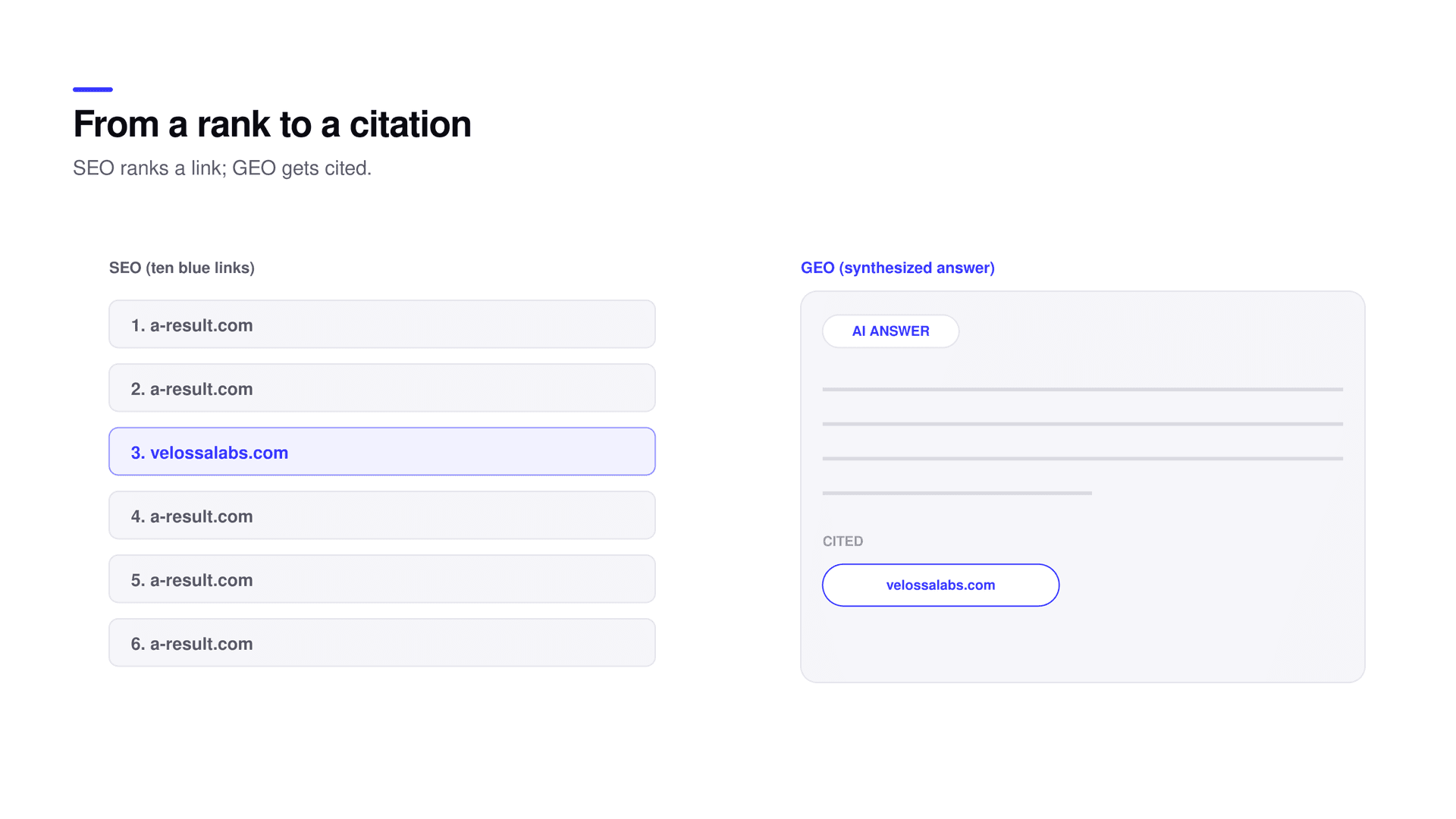
Most buyers used to find a company by scrolling a list of blue links. A growing share now ask an assistant instead, and the assistant reads the sources and answers for them. When that happens, ranking tenth on a results page is worth nothing, because nobody reaches the page. The goal shifts from being a link someone clicks to being the source an answer quotes. That shift has a name, generative engine optimization, often shortened to GEO or grouped with answer engine optimization, and product teams that treat it as somebody else’s job will quietly vanish from the place buyers now look first. This is a practical account of what earns a citation inside tools like ChatGPT, Perplexity, Gemini, and Google’s AI overviews, what recent guidance from Google actually changes, and how to measure something that barely registers in your analytics.
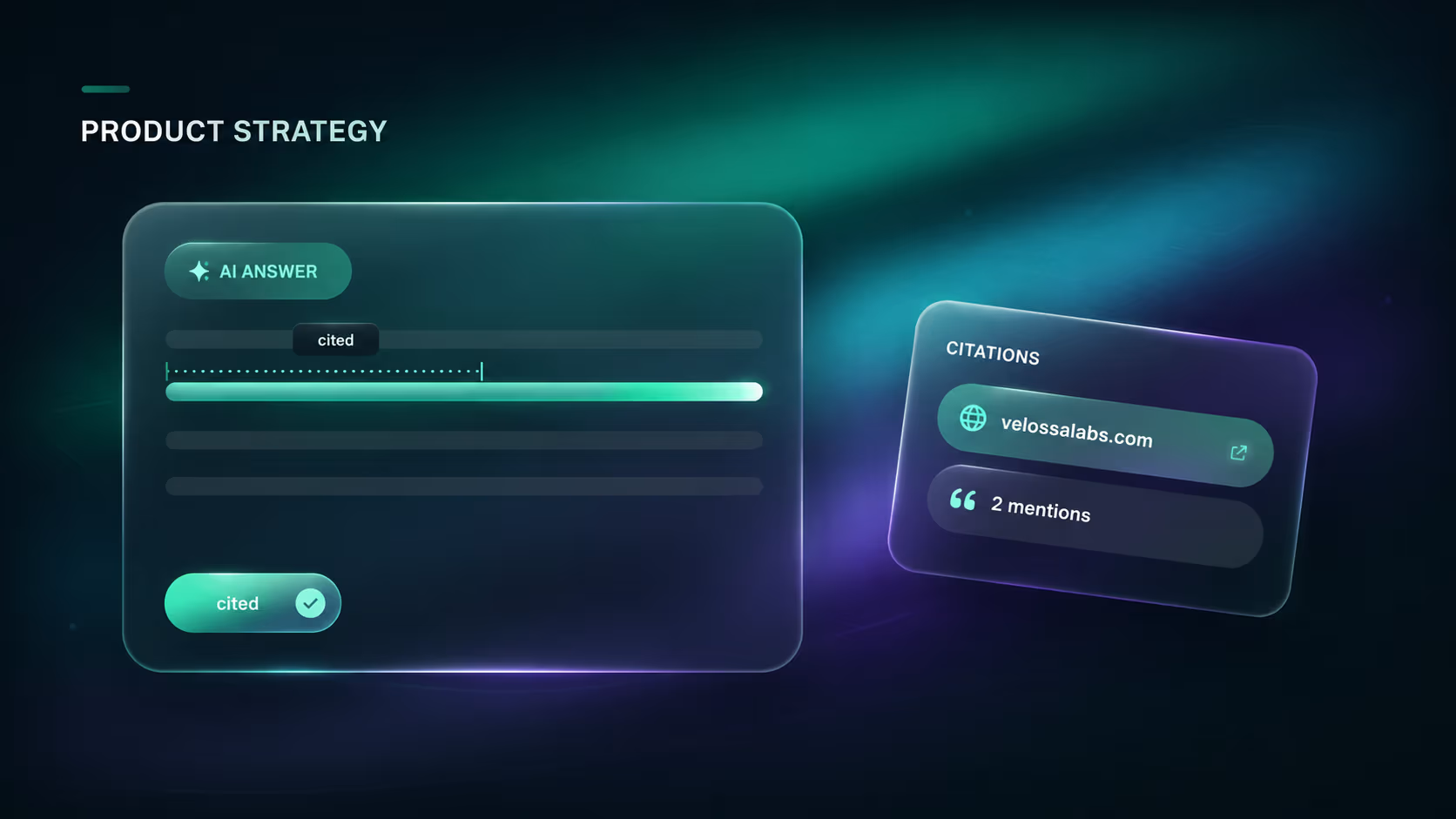
Search did not disappear. The reading step moved. Instead of ten results and a human deciding, an engine now retrieves several sources, synthesizes them, and hands back a paragraph with a few citations attached. Your job is no longer to win the click on a crowded page. It is to be the sentence the model lifts, with your name on it. That reframes what to optimize for. Backlinks and keyword density mattered when a human scanned a list. Clarity, originality, and clean structure matter when a machine extracts a claim and decides whether to attribute it to you.
| Classic search | AI answers | |
|---|---|---|
| Unit of success | A rank in a list | A citation inside an answer |
| Who reads first | A person scanning | A model synthesizing |
| What wins | Backlinks, keywords, freshness | Originality, clarity, structure |
| How you measure | Clicks, position, impressions | Mentions, citation share, inclusion |
| Failure mode | Buried on page two | Left out of the answer entirely |
It is worth clearing up a debate that gets loud online. In 2026 Google published guidance on optimizing for its AI features, and the blunt summary was that optimizing for generative results is optimizing for search, so it is still SEO rather than a separate discipline. The guidance also waved off several tactics people were selling: you do not need a special llms.txt file, you do not need to chop pages into machine-only chunks, you do not need AI-only rewrites of your copy, and you do not need exotic schema to be eligible. Read cynically, that deflates a lot of GEO hype. Read usefully, it is a relief, because it means the durable work and the citation work are the same work. Write genuinely useful, non-commodity pages, make sure they can be crawled, keep the page fast and clean, and cut duplication. The tactics that survive are the ones you would want to do anyway.
The one place to be careful is over-correcting. "It is still SEO" does not mean "do nothing new." It means the fundamentals carry more weight than the gimmicks. A page that states its answer early, offers something original, and is structured so any reader, human or machine, can find the point will be quoted. A page stuffed with keyword variants and thin restatement will not, no matter how much special markup you bolt on.
Three things do most of the work, and they compound. The first is answering the question early. Models tend to quote the clearest, earliest statement of an answer, so the classic essay structure that builds to a reveal in the final paragraph is exactly what loses. State the answer plainly in the opening, then spend the rest of the page earning it. The second is originality, covered in its own section below because it is the hardest and the most valuable. The third is structure a machine can parse without guessing, also below. None of these are tricks. They are what a hurried human reader wants too: the answer, stated once, clearly, where they expect it.
Put the answer first
The build-up-to-the-reveal shape that works for a personal essay is the shape that loses in AI search. Lead with the answer in the first paragraph, then support it. The model quotes the early, clear statement and ignores the throat-clearing before it.
If a page restates advice that lives on a hundred other pages, an engine has no reason to pick it over the ninety-nine alternatives, and every reason to blend them all into a generic paragraph that names nobody. The way out is to publish something only you have. That can be a benchmark you ran, with real numbers. It can be a dataset you collected from your own work or customers. It can be a named framework that packages a way of thinking so cleanly that people start using the name. A study of a hundred onboarding flows, an anonymized breakdown of what a category of projects actually costs, a rubric that turns a vague quality into five scorable dimensions: each gives a model a specific, attributable thing to quote, and specific quotes carry citations. Generic claims get absorbed; named, measured claims get attributed.
This is also the honest reason many pages will never get cited. They contain nothing that could not be generated from the average of the web, so the average of the web is exactly what they become inside an answer. Originality is not a style choice here. It is the mechanism.
Once you have something worth quoting, make it easy to extract. Phrase headings as the questions people actually ask, and answer each one directly underneath, so a single passage can be quoted without dragging in unrelated text. Keep one idea per section. Use a list or a table when the content is comparative, because structured content extracts cleanly and ambiguous prose does not. Name your entities consistently, the product, the method, the framework, so a model can resolve who is making the claim rather than attributing it to nobody. Google may not require special schema for eligibility, but an FAQ block and a clear author still help human readers and several non-Google engines, and they cost almost nothing. The goal throughout is the same: reduce the number of guesses a reader has to make, whether that reader is a person skimming on a phone or a model assembling an answer.
Here is the trap that makes teams give up too early. AI platforms cite sources far more often than they send traffic, so if you judge GEO by referral clicks in your analytics, it will look like nothing is working while your influence quietly grows. Change what you count. Keep a standing list of the twenty questions a buyer in your space would type into an assistant, and once a month run them through the major tools and record where you are named or linked. Treat that citation share the way you used to treat backlinks: the new shelf space. The brands winning this shift are building citation share deliberately while their competitors wait for referral traffic that no longer arrives in the same volume.
| Old metric | What to watch now |
|---|---|
| Keyword ranking | Citation share across a fixed question set |
| Organic clicks | Times named or quoted in AI answers |
| Backlinks | Distinct engines and answers that cite you |
| Impressions | How often your target questions include you |
Build a prompt panel
Pick twenty questions your buyers ask an assistant, run them monthly through the major tools, and log where you appear. That standing panel is your GEO dashboard until the tracking tools mature, and it takes an hour a month.
A fair skeptic raises three points. Is this a fad? Partly the vocabulary is, and Google’s "it is still SEO" framing is a useful corrective, but the underlying behavior, people getting answers from assistants, is not going back. Will AI simply kill your traffic? It will change its shape: fewer casual clicks, but higher-intent visits from people who already saw you cited and came looking. And do you have to game it? No, and trying to is the losing move, because the systems are built to reward exactly the originality and clarity that gaming replaces. The most durable position is to be genuinely worth quoting, which is inconveniently also the hardest.
Before you publish, run the page against six questions. Does it state its answer in the first hundred words? Does it contain one original thing, a number, a dataset, or a named idea, that a competitor could not copy from a template? Are the headings phrased as real questions and answered directly beneath? Are the key entities named consistently so a model knows who is speaking? Is there an FAQ and a clear author? And is the page indexable, fast, and free of near-duplicate siblings? Six yeses is a page built to be cited.
When an assistant answers for your buyer, being the source it names is the new first result. Everything else is page two of a page nobody visits.
What is generative engine optimization (GEO)?
It is the practice of making your content the source an AI assistant cites when it answers a question, rather than just a link that ranks. In practice that means answering early and clearly, publishing something original, and structuring the page so a model can extract and attribute your claim.
Is GEO different from SEO?
Google’s own guidance frames optimizing for AI results as still being SEO, not a separate discipline. The tactics that matter, useful non-commodity content, clean structure, and crawlability, are the durable SEO fundamentals. The mindset shift is that the unit of success is a citation inside an answer rather than a rank in a list.
Do I need an llms.txt file or special schema to rank in AI answers?
According to Google’s guidance, no. Special AI-only files, forced content chunking, and exotic schema are not required for eligibility. Standard structured data and a clear FAQ still help human readers and some engines, but the bigger levers are originality, clarity, and answering the question early.
How do I measure whether AI is citing my content?
Not through referral clicks, which understate it. Keep a fixed list of buyer questions and run them monthly through ChatGPT, Perplexity, Gemini, and Google’s AI overviews, logging where you are named or linked. That citation share is the metric to track.
How long should a GEO-friendly article be?
Length is not the lever. A focused page that answers early and includes something original will be cited more than a long, generic one. Write enough to be genuinely useful and no longer.
Search is not vanishing, it is changing who reads first. Answer the question at the top, publish something only you have, structure the page so a model can lift it cleanly, and measure the citation instead of the click. Do that and you earn a place inside the answer itself, which is the most durable distribution available right now. The same discipline of deciding what is worth saying applies to scoping an MVP that proves one claim and to reasoning about what design work is worth. If you want this built into your product’s content rather than described, start a conversation about it.
Related reading