6 min read
Scoping an MVP that can actually raise the next round
Most MVPs are either too thin to prove anything or too bloated to ship. How to scope the version that moves your metrics and your raise.
MVPfoundersproduct strategy

Product Strategy
A straight answer for founders on what product design actually costs, what drives the number, and how to spend it well.
TL;DR
The honest answer is that it depends on scope, and the useful version of that answer explains exactly what moves the number so you can reason about your own situation instead of guessing or feeling quoted at random. Founders deserve the mechanics, not a vague "it varies," and they deserve real ranges to anchor on, with the caveats that keep ranges honest. Three forces drive the cost of product design. Understanding them tells you both what you are likely to pay and, more usefully, how to spend it well, which is the part most cost conversations skip entirely.
What drives the number
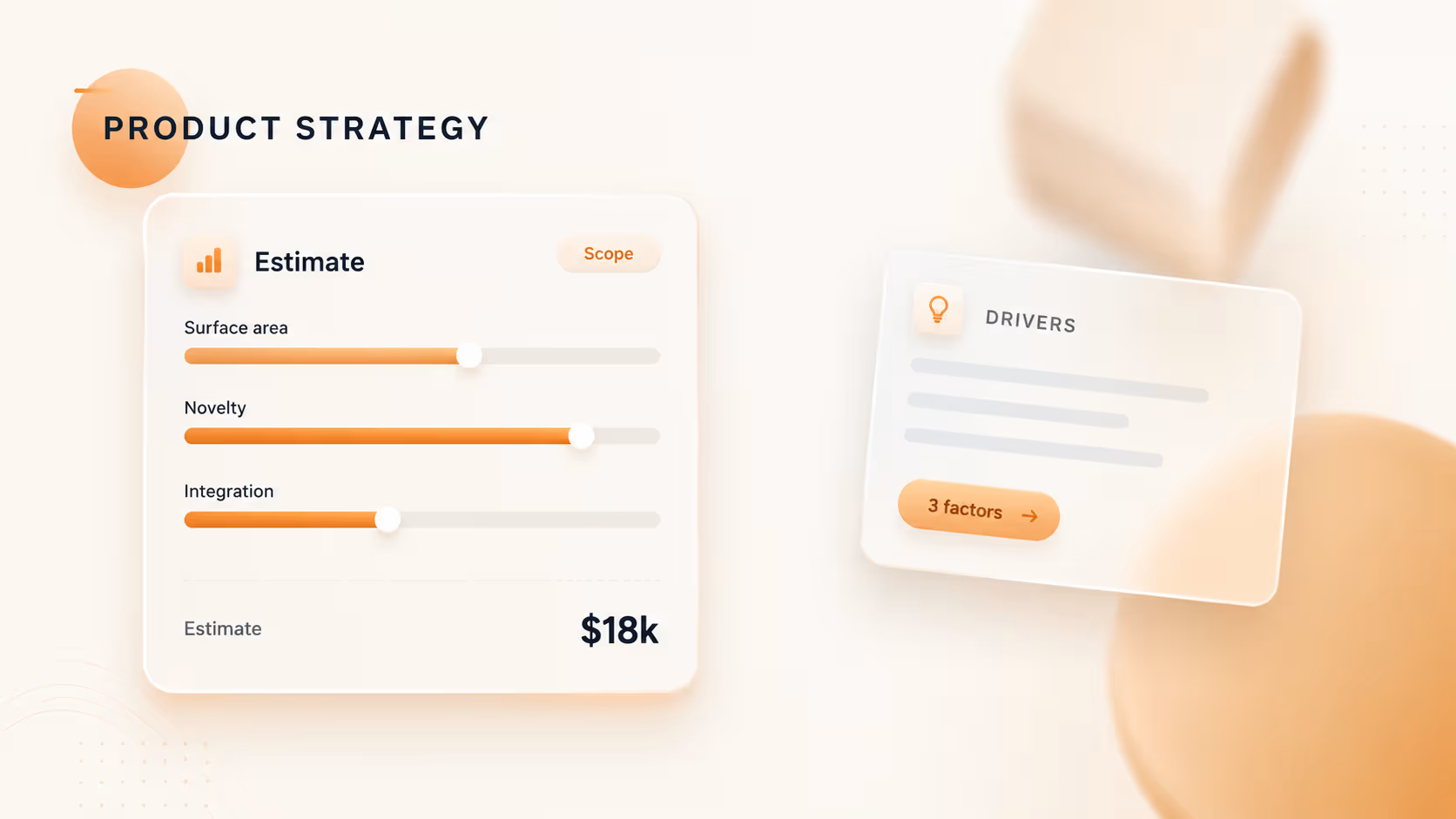
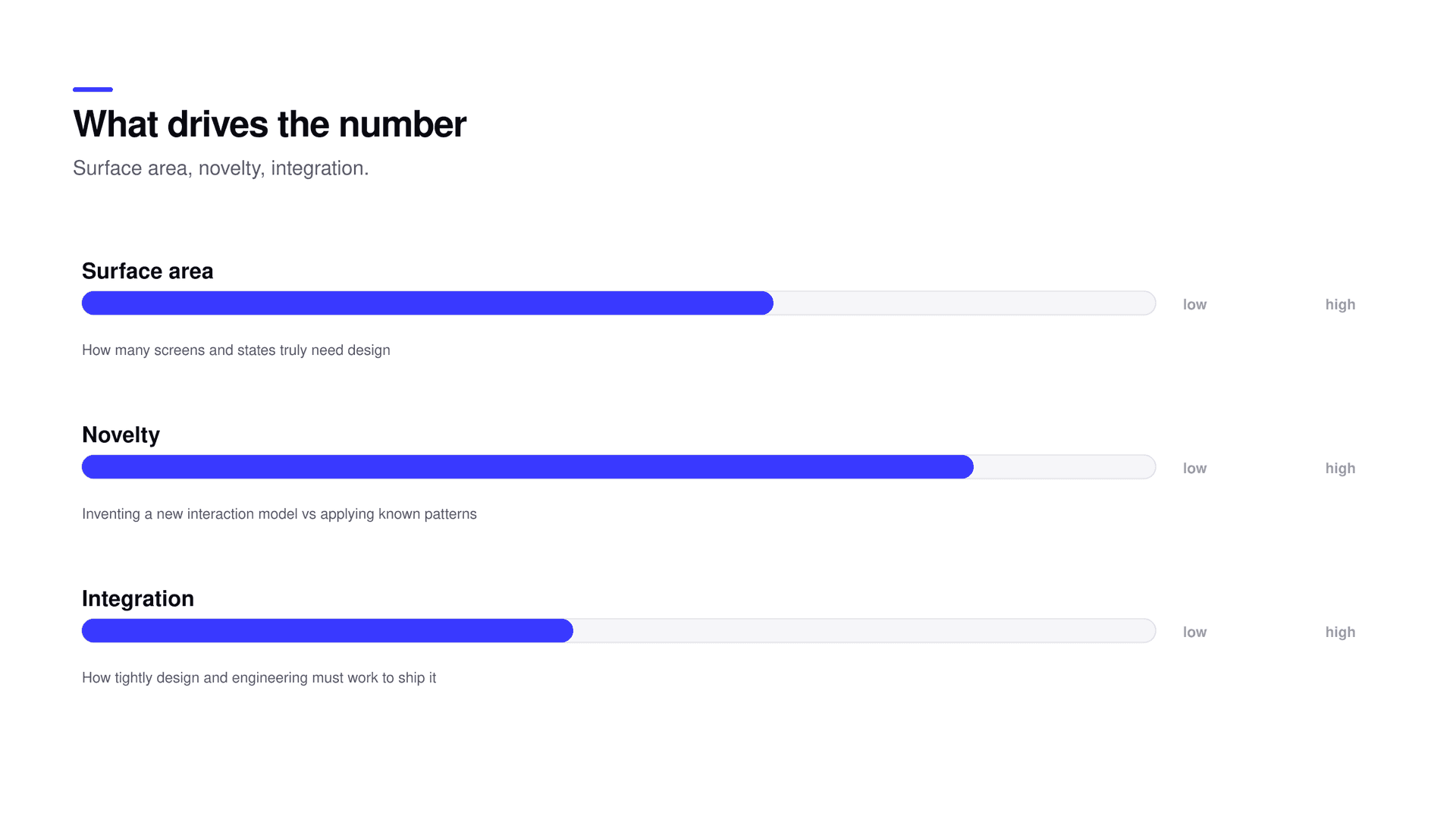
Surface area is how many screens and states genuinely need design. Not the grand vision, the actual flows a first real version requires, counted honestly. Novelty is how much you are inventing rather than applying: reaching for known, well-understood patterns is fast, while inventing a genuinely new interaction model is slow and iterative because it has to be tried, tested, and reworked. Integration is how tightly design and engineering must work together to ship it well, which runs high for anything real-time, data-heavy, or deeply interactive, and low for anything mostly static. A simple marketing site is low on all three. A real-time trading interface is high on all three. Most products sit somewhere in between, and where they sit on each of the three is most of your estimate before anyone has quoted you a number. Score your own product one to five on each and you have the rough shape of the cost.
Real numbers help you reason, so here is an orientation map with the honesty that makes it useful: these are broad market ranges that vary a great deal by region, seniority, and scope, and they are not a price anyone is quoting you. A focused, well-scoped project tends to land somewhere in the low-to-mid five figures. Ongoing design usually works better as a monthly engagement than a per-screen bill, because a live product keeps evolving and a per-screen model quietly punishes iteration. Hourly senior work exists for advisory and spot needs where you want judgment without a full engagement. And an in-house hire trades a project cost for a salary plus the ramp time before the person is fully productive on your product.
| Engagement | Typical range | Best for |
|---|---|---|
| One-off project (focused MVP) | ~$8k to $40k+ | A defined scope with a clear finish line |
| Monthly design subscription | ~$4k to $12k / mo | An evolving product that needs steady output |
| Fractional / senior hourly | ~$100 to $250 / hr | Advisory, audits, or spot work |
| First in-house hire | Salary + ramp | Steady, core, everyday design |
Where to spend
Put the budget where the risk is highest: the core flow, the first-run experience, and anything a customer pays through. Everything else can follow established patterns. Match the investment to the stakes and the total takes care of itself.
The most expensive option is rarely the highest quote. It is the cheap engagement that produces beautiful screens nobody can actually build, or a product that ships on time and does not perform, so the money bought motion instead of a result. Value comes from work that ships and moves your metrics, and that is a function of judgment, not pixel count. This is why "how many screens" is the wrong first question and quietly leads teams to buy the wrong thing. The right question is "what decisions does this product need to get right," because those decisions are what you are actually paying for, and getting one core decision wrong, the pricing model, the central interaction, the first-run experience, costs far more than any line item on a quote.
Take a seed-stage business tool. About a dozen core screens is moderate surface area. One genuinely new data-visualization interaction pushes novelty high, because it has to be invented and validated rather than borrowed. Real-time sync across users pushes integration high. Two of the three drivers high lands the work in the mid-to-upper part of the project range, and it is worth it there, because the novel interaction is the entire reason the product is interesting and worth building carefully. Contrast that with a marketing site: low surface, low novelty, low integration, bottom of the range, and spending more would be pure waste. The warning hidden in the comparison is the cheap quote that ignores the drivers. If a price comes in far below what the drivers suggest, someone is planning to skip the novel interaction, under-design the states, or hand you screens that are not buildable, and you will pay the difference later with interest.
Scope to the claim your next milestone depends on, not the full eventual vision, so you are not paying to design features that will change before they ship. Reuse patterns everywhere the product is not differentiated, and save the custom work for the few places users actually judge you. Bring engineering in early so design decisions are buildable and you do not pay twice to redraw the unbuildable. And resist polishing the parts no one will ever see or judge. The teams that spend well are ruthless about concentrating quality where it changes the outcome and using conventions everywhere else, which is, not coincidentally, the same discipline behind scoping an MVP that actually raises.
The real cost of product design is the cost of the decisions that matter, spent where the risk is. Everything else should follow a pattern.
How much does product design cost?
It depends on surface area, novelty, and integration. As a rough orientation, focused projects often run from the high four figures into the low five figures and up, ongoing work commonly runs a few thousand a month, and senior hourly work sits in the low hundreds per hour. Your number depends on how your product scores on the three drivers.
Should I pay per project, on retainer, or by subscription?
Per-project fits a defined scope with a clear finish. A monthly subscription or retainer fits a product that keeps evolving, because design is continuous rather than a one-time deliverable. Hourly fits advisory and spot work. Match the model to whether the work is bounded or ongoing.
Why do studios cost more than freelancers?
A studio brings a team’s range, strategy, interface, motion, and engineering, plus senior judgment and a standard, without you hiring for each skill. You pay for decisions that ship and hold up, not just hours, which is usually cheaper than the rework a mismatched cheap option creates.
How do I reduce cost without wrecking quality?
Scope to the one claim your next milestone needs, reuse patterns wherever you are not differentiated, involve engineering early, and concentrate custom work on the core flow. Cutting scope beats cutting quality on the parts that matter.
What is a red flag in a cheap design quote?
A price far below what surface area, novelty, and integration suggest usually means someone plans to skip the hard interaction, under-design the states, or deliver screens that are not buildable. You pay that difference later in rework.
So the real answer to "how much does product design cost" is: as much as the decisions that matter are worth, spent where the risk is. Reason about surface area, novelty, and integration, anchor on the ranges as orientation rather than a quote, and put the money on the flows that make or break the product. If you are weighing how to staff it, hiring a designer versus working with a studio is the companion decision, and if you would rather see the number for your specific product, describe what you are building.
Related reading