
Explainable AI UX: patterns for "why am I seeing this?"
As products make more decisions on the user's behalf, trust becomes an interface problem. These are the patterns that make AI legible instead of magical.
AI & Design
Prompting is a design skill now. A repeatable structure that gets useful output from AI tools without the guesswork.
Prompting is a design skill now. The people getting real leverage from AI tools are not writing magic incantations, they are writing good briefs. The same clarity you would give a collaborator gets you better output from a model, and the same vagueness gets you the same mush.
This is the structure we use, the way we iterate, and the honest ceiling on what prompting can do.
The structure
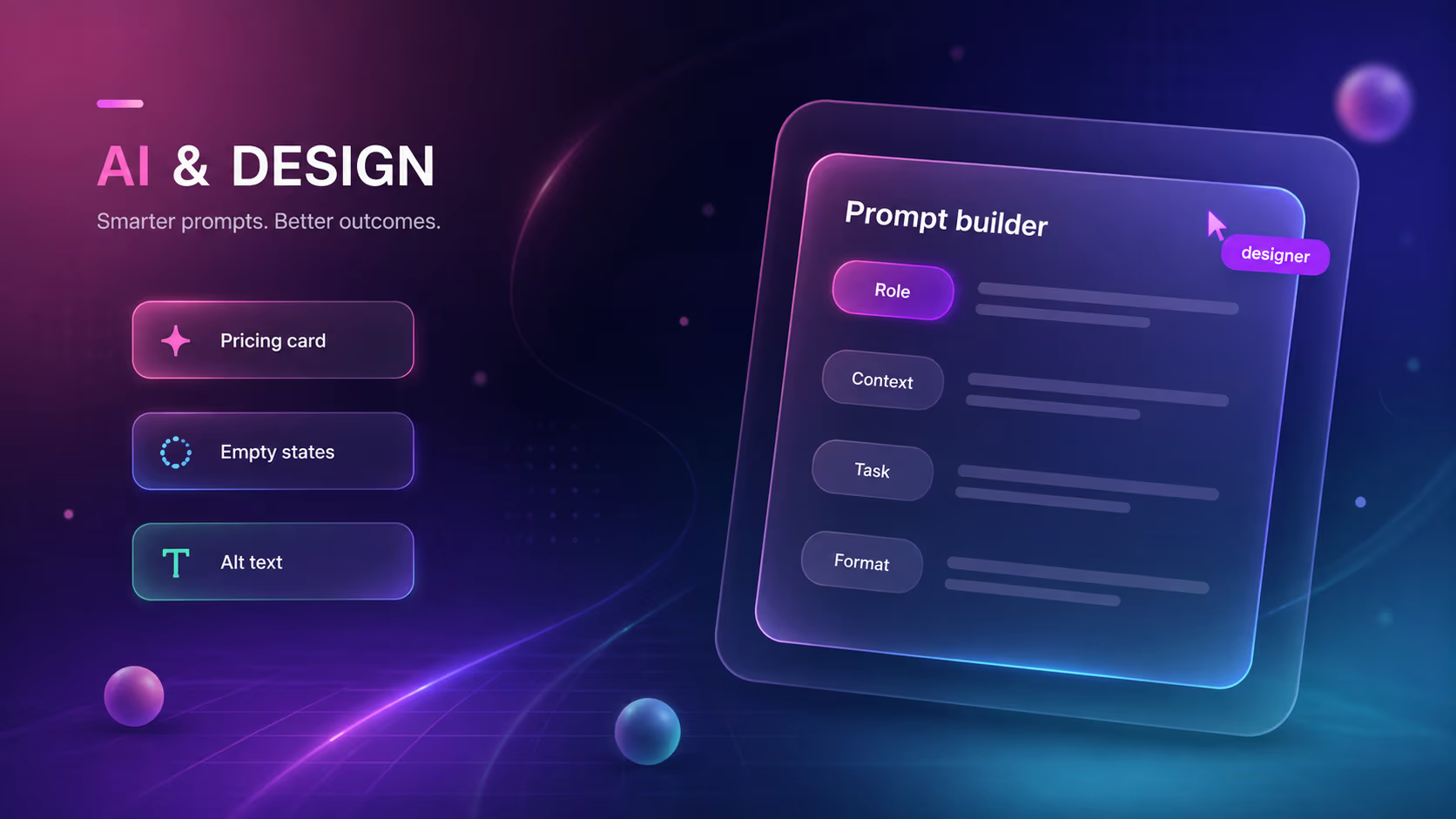
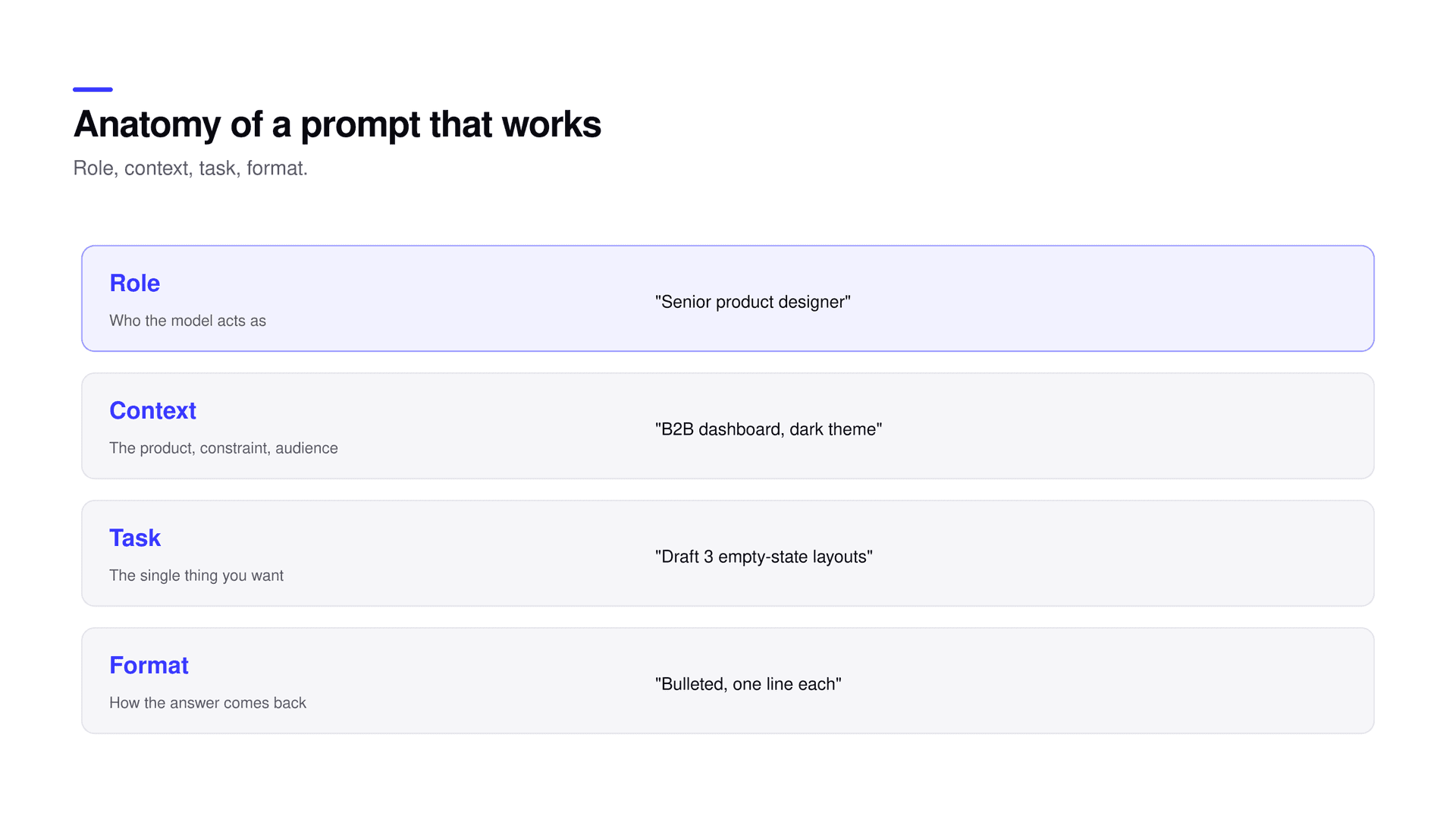
Every strong prompt has four parts. Role: who the model is acting as, which sets the vocabulary and standard. Context: the product, the constraint, the audience, the thing it needs to know to be useful. Task: the single specific thing you want, not three things at once. Format: how the answer should come back, so you get something usable instead of an essay you have to reformat.
Miss any of the four and quality drops in a predictable way. No role and the tone is generic. No context and the answer is plausible but wrong for your situation. No clear task and it wanders. No format and you spend as long cleaning the output as you saved.

Written by
Jayesh Velossa
Founder & Creative Director
The single biggest mistake is expecting the first output to be the answer. It is a draft. Get a rough direction, then refine with specific corrections rather than restarting from scratch. 'Make the second option shorter and more direct' beats regenerating and hoping.
Treat it like a design review with a fast collaborator. You are steering, not commissioning.
Keep a prompt library
When a prompt works, save it. Treat prompts like components: named, reusable, and improved over time. A small library of proven prompts is worth more than any single clever one.
Models are strong at breadth and drafts, weak at taste and truth. Use them to widen the option space fast, then bring your judgment to close it. They will confidently produce something wrong, so anything that matters gets verified. The prompt gets you a good starting point; it does not get you off the hook for the decision.
Good prompting is just good briefing plus the humility to treat the output as a draft. Structure the ask, iterate in passes, save what works, and never outsource the judgment. Do that and AI becomes a genuine multiplier on the mechanical parts of design work.