
The AI-native design workflow: how our studio actually uses AI end to end
AI is not a magic button. It is a set of leverage points across research, exploration, and production. Here is exactly where we apply it, and where we deliberately do not.
AI & Design
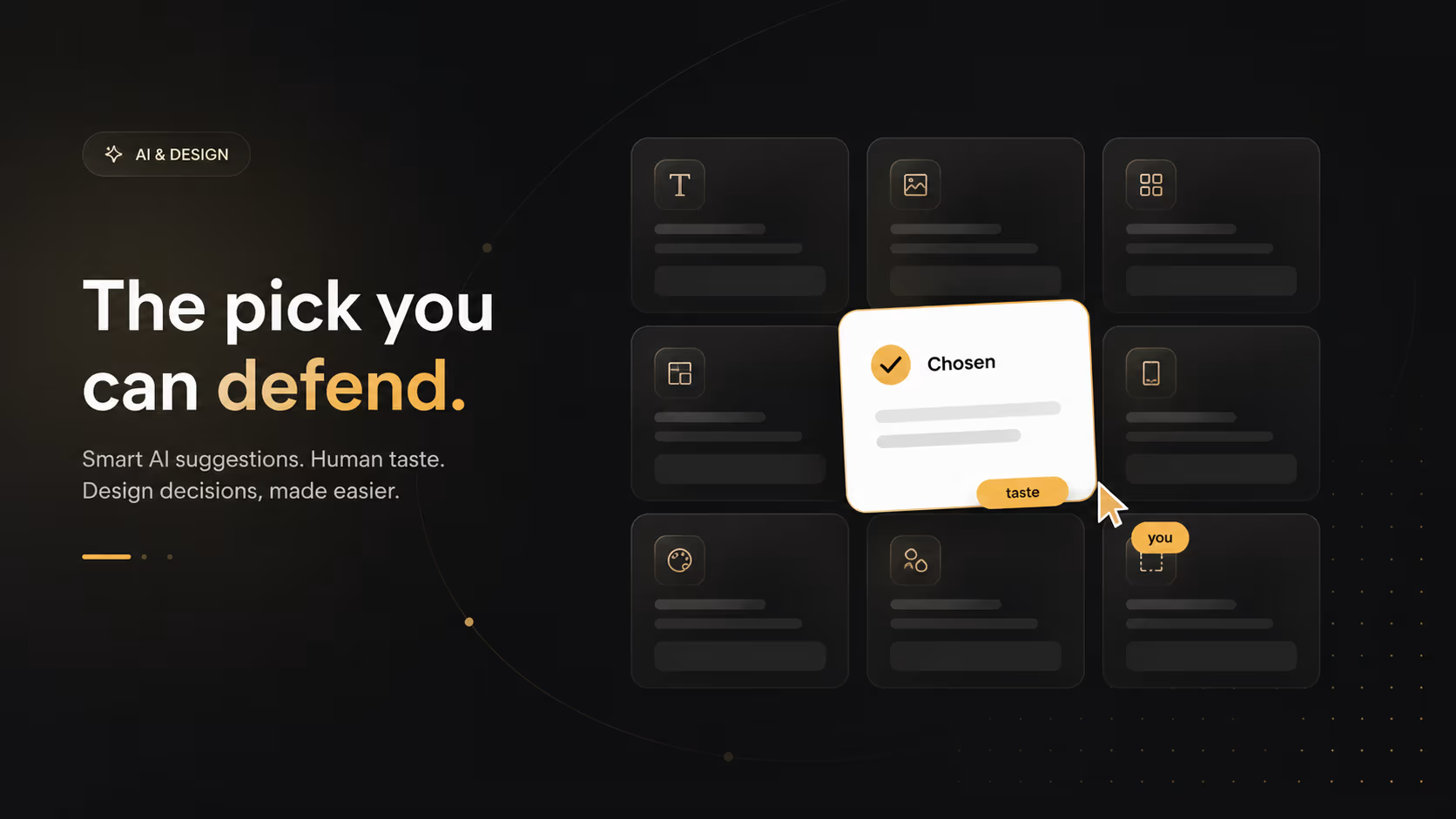
When anyone can generate a decent interface in a minute, decent stops being worth anything. The scarce asset is taste. Here is how to separate it into jobs you can actually do, score it, and defend it.

TL;DR
For twenty years the bottleneck in digital product work was production. Someone had to draw every screen, write every state, and rebuild it all in code. Design was expensive because making was expensive, and a lot of what looked like taste was really just the ability to produce clean work at all.
That bottleneck is gone. A founder with a prompt can generate a competent landing page, a dashboard, and a settings screen before lunch. The floor rose to a place that used to take a junior designer a week to reach. And here is the part most people have not sat with yet: when the floor rises for everyone at once, standing on the floor is worth nothing. A capability everyone has is not a differentiator. It is table stakes.
So the value did not disappear. It moved. It moved up, from making the thing to deciding what the thing should be. That decision layer has a name people are reaching for from every direction right now, and the name is taste. The trouble is that taste is usually discussed as an ineffable quality you either have or you do not, which makes it useless as a thing to build a studio, a team, or a career around. The goal of this piece is to make it concrete enough to hire for, score, and teach.
Why generated design looks the same
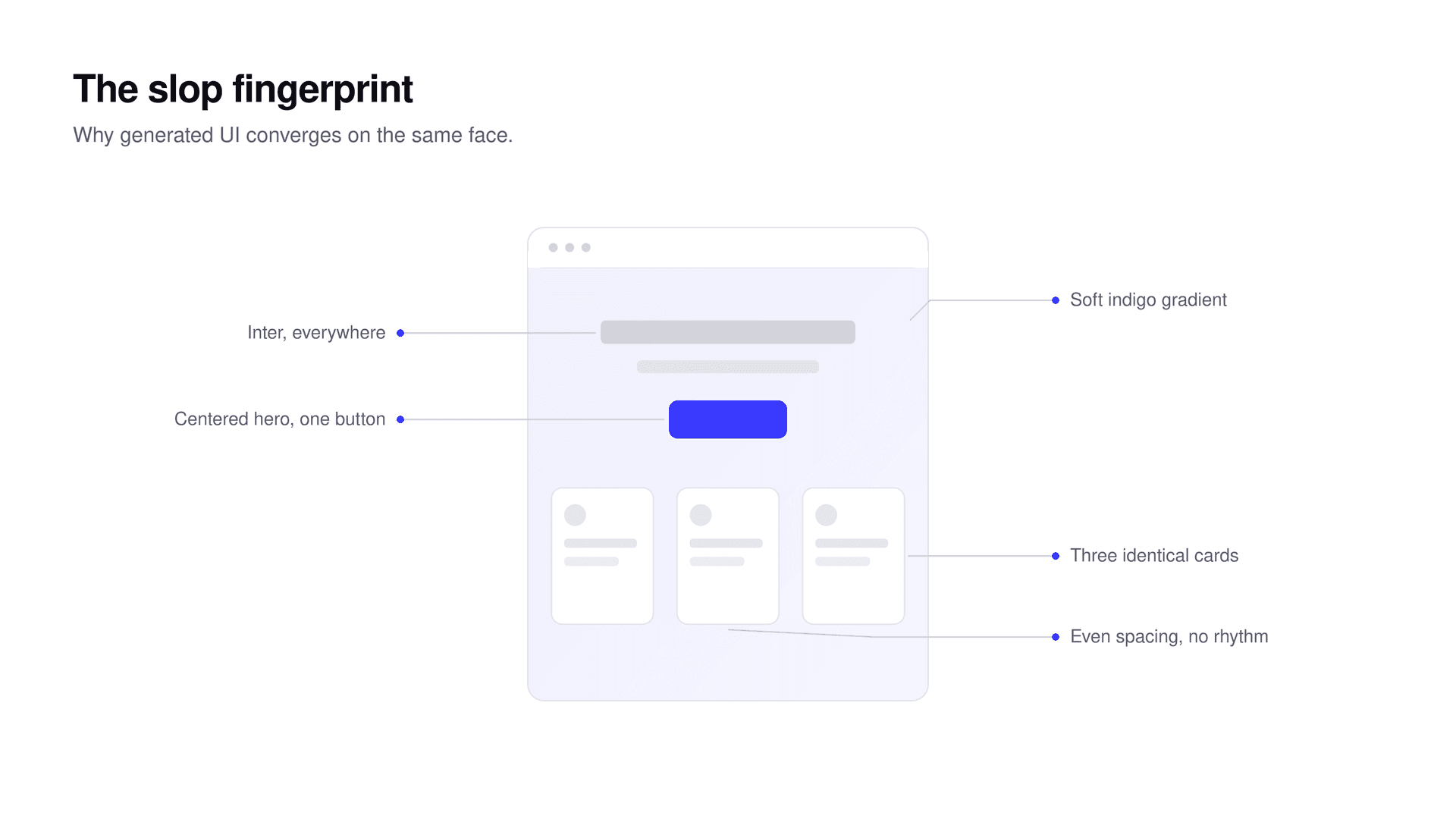
Look at enough AI-generated interfaces and you start to see the same face staring back. The Inter typeface. A centered hero with one button. Three rounded feature cards in a row. A soft indigo gradient in the background. Even spacing with no rhythm to it. People have started calling this the slop fingerprint, and the reason it exists is not laziness. It is math.
A model generates by predicting the most likely next thing, and the most likely thing is the average of everything it has seen. The tutorials, the templates, and the starter kits that saturate its training data all pull toward one center, so the output converges on that center. The result is technically fine and completely forgettable. It is the visual equivalent of a sentence with no accent: grammatically correct, and impossible to remember.

This is the whole opportunity, stated as a picture. If generation pulls toward the average, then anything genuinely considered pulls away from it, and pulling away from the average is exactly what taste does. The market is about to be flooded with products that all look like the same first draft. The ones that feel like a specific human made a specific set of choices will stand out more than they have in years, not less.
The framework
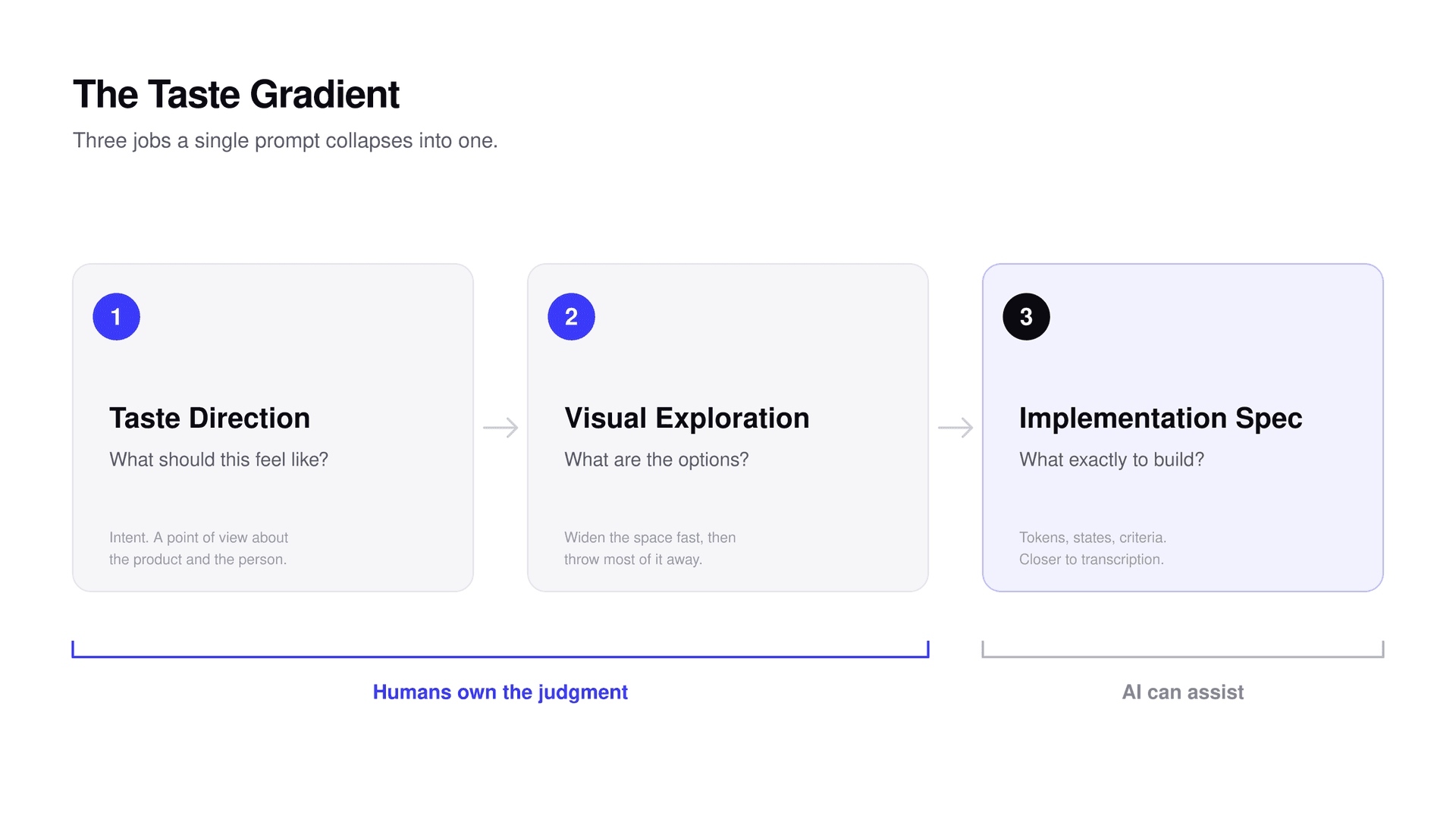
The reason "just use taste" is unhelpful advice is that taste is not a single act. When you ask a model to "design something tasteful," you are secretly asking it to do three different jobs at once, and it does all three at the level of the average. Pulling those jobs apart is what makes taste operable. We call the model the Taste Gradient, because the three jobs sit on a gradient from pure judgment to pure production, and AI is useful at exactly the opposite end from where the value is.

1. Taste direction: what should this feel like? This is the intent behind everything else. It is the decision that a fintech product for anxious first-time investors should feel calm and certain, not slick and aggressive, and that this specific calm means restraint in color, weight in the typography, and motion that settles rather than bounces. Direction is a point of view about the product and the person using it. A model has no point of view. It has an average of everyone's points of view, which is not the same thing and is often the opposite.
2. Visual exploration: what are the options? This is where AI is genuinely, powerfully useful, and where most people misuse it. The job here is to widen the space of possibilities fast and cheap, so you do not fall in love with your first idea. Ask for a dozen throwaway directions precisely because you plan to throw eleven of them away. The value is the range, not any single output. The mistake is treating exploration as the answer instead of the raw material for one.
3. Implementation spec: what exactly to build? This is the most mechanical job: the exact spacing, the token names, the component states, the acceptance criteria. It is real work, but it is closer to transcription than judgment, and it is where AI assistance pays off with the least risk. A spec is right or wrong in a way a direction never is.
| Job | What it decides | Can AI do it? | What the human owns |
|---|---|---|---|
| Taste direction | What this should feel like | No, it averages every stance | The stance itself |
| Visual exploration | The options to react to | Yes, powerfully; volume is the point | Which option is right |
| Implementation spec | Spacing, tokens, states, criteria | Mostly; it is near transcription | The acceptance bar |
The failure mode that produces slop is collapsing all three into one prompt and letting the model supply the average for the one job that should never be averaged: direction. When you skip direction, you get a product that is competently built toward nothing in particular. It has options and a spec but no point of view, and a point of view is the only thing a person on the other side of the screen can actually feel.
Making it auditable
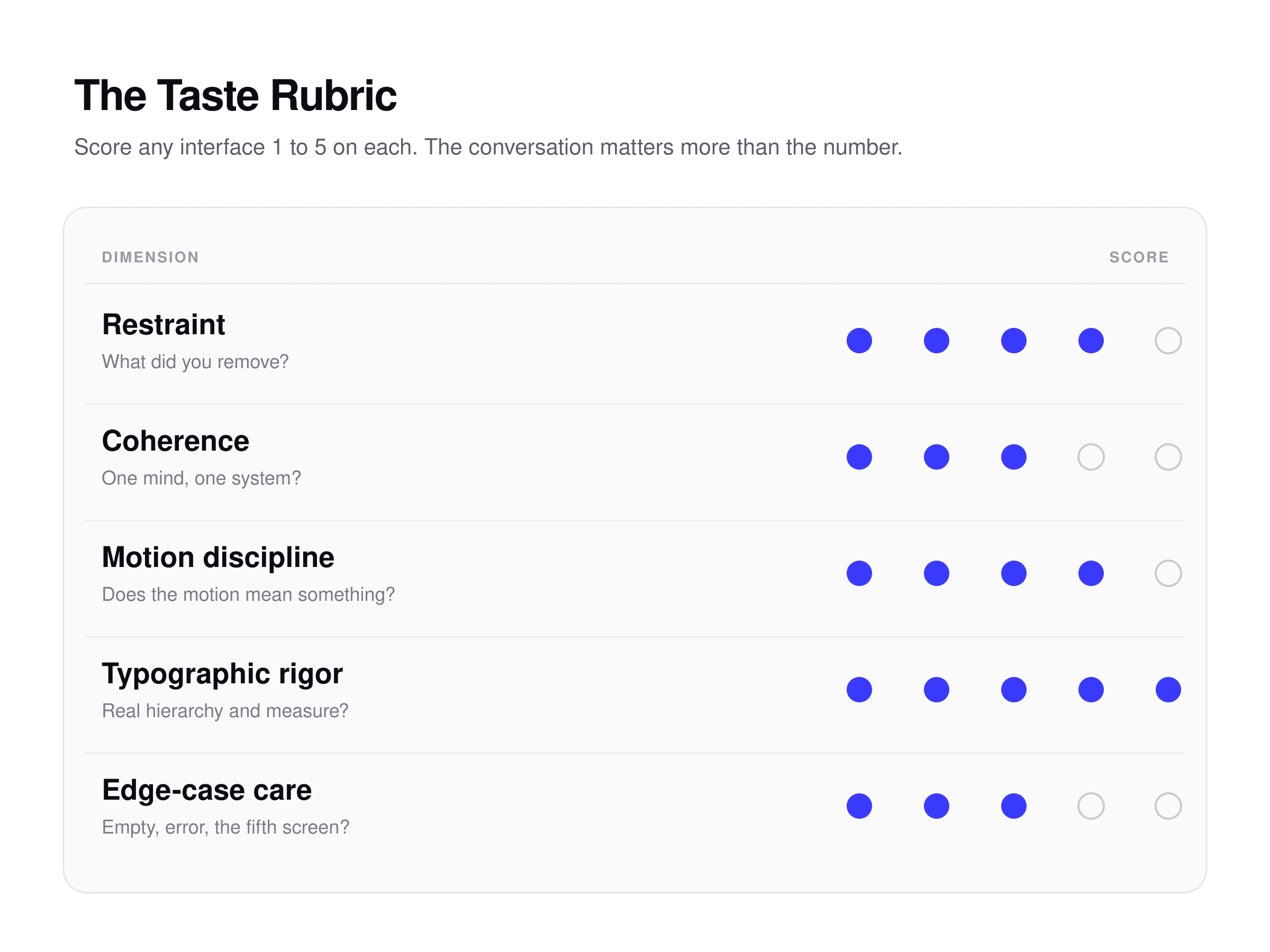
If taste were truly unmeasurable, you could not critique a junior's work, and every senior designer does that every day. What they are doing is applying an internal rubric they have never written down. Here it is, written down. Score any interface from one to five on each dimension, and the number is less important than the conversation it forces.

Run this on your own product honestly and it will tell you where you sit relative to the average. Most products that feel generated fail on restraint, coherence, and edge-case care, in that order.
Rule of thumb
Generators flood; filters are trusted. When making is free, your value is not what you can produce. It is what you are willing to delete, and the point of view that tells you what to cut.
The honest objection to all of this is that taste is not a moat at all, because taste is copyable. A competitor can screenshot your product, feed it to a model, and ask for more like it. The distinctive look that took you months becomes a style anyone can request in a sentence. And models keep improving, so whatever gap exists today closes tomorrow. This is a real argument, made by serious people, and pretending it is wrong would be its own kind of slop.
Where it is right: a surface style is copyable, and getting easier to copy. If your entire differentiation is a color palette and a font pairing, you do not have a moat. You have a look, and looks are now cheap to reproduce.
Where it breaks down: taste as applied judgment inside a specific product and system is a very different thing from a look. It is a thousand context-dependent decisions about this user, this constraint, this business, this edge case, made coherently over time. A screenshot captures the output of that judgment at one instant. It does not capture the judgment, and it cannot regenerate the next thousand decisions the same way. The moat was never the pixels. It is the reliable ability to make the right call again, in a new situation, faster and more coherently than the competition. That compounds, and it does not fit in a screenshot.
When execution is free, the only thing left to sell is knowing what is worth making. That is not a look you can copy. It is a judgment you have to build.
VelossaLabs
Taste is treated as innate because it is usually invisible, but it is built the way any expertise is built: through high-quality reps with fast, honest feedback. Here is the practice that develops it deliberately.
This is close to how we work at VelossaLabs. We use AI aggressively for the middle job, visual exploration, to widen the space and move fast, and we guard the two ends where judgment lives. The same discipline shows up in how we think about the AI-native workflow and about where quality leaks between design and production, and it is why craft in the details, not just the concept, is the thing we actually sell. If you want to see it in a shipped product rather than a diagram, the CineTrade case study is a fair place to judge us. And if trust and legibility matter as much as looks for your product, the patterns for explainable AI are the companion to this piece.
Common questions
Isn't taste just subjective?
Partly, but far less than people assume. There is a wide band of decisions that are simply better or worse for a given intent, and the rubric makes most of them discussable. Reasonable people disagree at the edges; they agree far more than the word subjective suggests.
Won't AI develop taste eventually?
It will get better at the average and at mimicking a supplied style. What it cannot supply is a point of view about a specific product and user, because a point of view is a stance, and a model optimizes toward the center of all stances.
Can you actually measure taste?
You can score it against defined dimensions, which is enough to critique, hire, and improve. The score is a conversation starter, not a grade. A shared language is the point, not precision.
How is this different from a design system?
A design system encodes decisions you already made so they scale. Taste is the judgment that makes those decisions in the first place, and that decides when to break the system. You need both.
Do I need a studio for this?
No. You need someone who owns the direction job and can hold the rubric. That can be an internal design leader. A studio is worth it when you want that judgment at a high level immediately and cannot wait out a hiring cycle.
The next few years will produce more competent, forgettable products than any period in the history of software, because competent is now free and forgettable is the default output of the tools everyone shares. That is not a threat to design. It is the best case design has had in a long time, because contrast is worth more when the background is noisy.
Reduce taste to something you can do on purpose. Separate the direction from the exploration from the spec, use the model where it helps and guard the ends where it does not, score the work against a rubric instead of a feeling, and build the judgment on your team like the skill it is. Do that and you are not competing with the flood. You are the reason someone remembers your product in a market where everything else looks like the same first draft. If that is the bar you want to hit, start a project with us or read more about how we think.
Related reading